
Recent Research
AARP’s Living Alone: What Solo Agers Want You to Know study finds that many Americans age 50 and older who live alone without a partner or children report high levels of satisfaction, autonomy, and social engagement, while also expressing concerns about loneliness, future health declines, and financial security as they age
Survey of Financial Perspectives and Retirement Planning for Solo-Agers, Society of Actuaries
The SOA Research Institute engaged a market research firm to survey a sample of Americans 50 years old and older who self-identify as solo-agers. Among the objectives of the survey was to explore American solo-agers’ attitudes towards, and changes in, their finances, use of technology, and physical and cognitive abilities as they age. In addition, to understand the extent to which they are using, or anticipate using, a support network as they age.
Solo Aging in New England: Findings from the 2025 Healthy Aging Data Report, UMass Boston Gerontology
Experiencing later adulthood as a solo ager is gaining increasing research interest and adults who have never married are a major component of solo agers. This research describes community rates of adults 65+ who have never been married, the percentage of older adults who have annual incomes below the poverty level, and community medical service utilization rates (ER visits, and annual physician visits) in CT, MA, and RI.
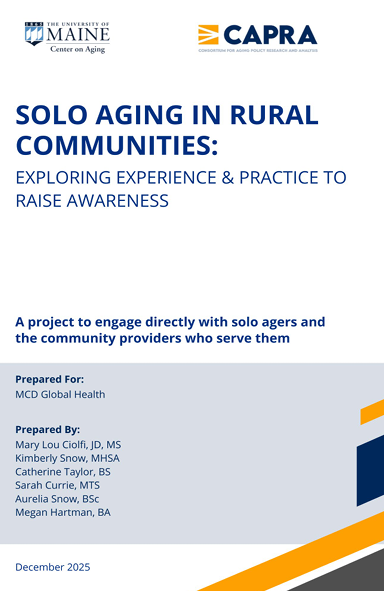

Solo Aging in Rural Communities: Exploring Policy and Practice to Raise Awareness, University of Maine
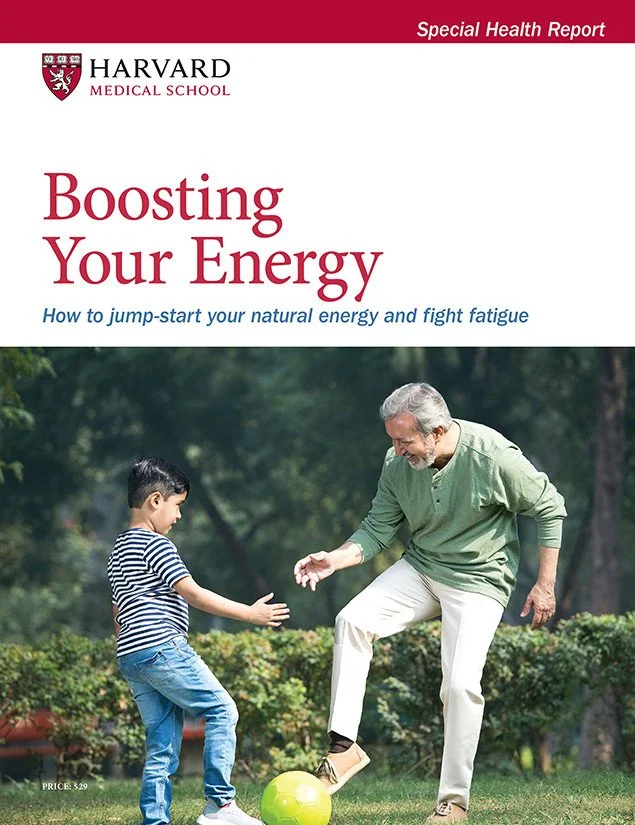
Staying Healthy: Solo aging: Who can you rely on?, Harvard Health
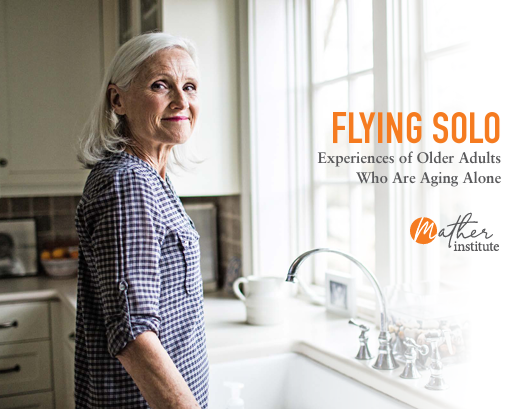
Flying Solo, Mather Institute
The Way Older Childless Women Value Their Life—A Qualitative Study, Behavioral Sciences: Special Issue Social Interactions and Aging
Going It Alone, KFF Health News
This study examines the relationship between living alone, self‑rated health, and loneliness among a sample of older Black women, incorporating neighborhood characteristics such as residential segregation and social capital into hierarchical linear models. It aims to clarify how living alone without close family or kin intersects with health and loneliness in an urban context where community factors may influence wellbeing.
CAPRA co-directors, Mary Lou Ciolfi and Kimberly Snow partnered with MCD Global, with funding from the federal Health Resources and Services Administration (HRSA) to explore what rural health and social service providers know about solo aging and how older adults aging alone experience the benefits and worries of solo aging. The project generated a solo aging resource website and a final report to raise awareness of the solo ager experiences — both concerns and strengths.
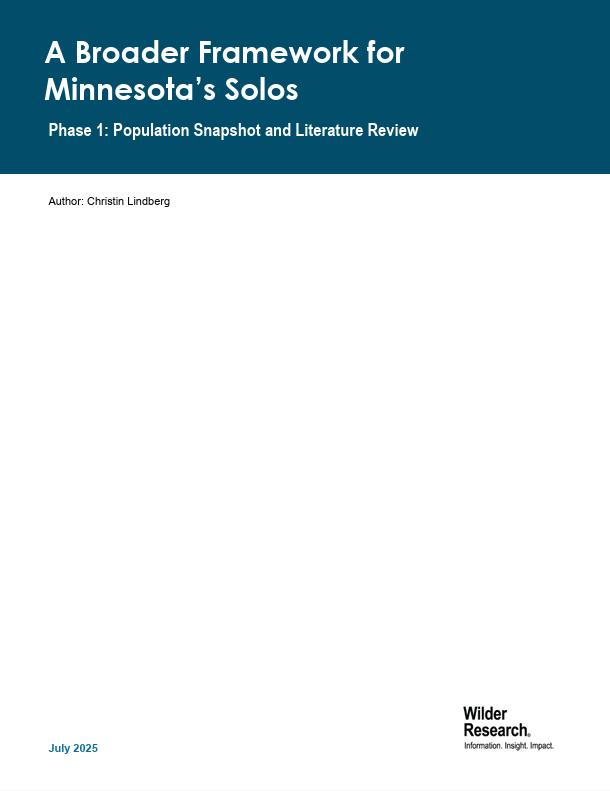
This report is the first part of a phased approach to expand on previously completed work about solos. The overall goal of Phase 1 is to summarize current data on:
Characteristics and circumstances of solos in Minnesota
Solos’ access to services across Minnesota
Literature references related to ways in which solos interact with systems and systems may work to address the unique needs of solos
The share of childless women increased in every age group except those ages 45 to 50, according to recently released data from the U.S. Census Bureau’s Current Population Survey Fertility Supplement.
As more older Americans live alone, finding connection and care poses a challenge.
This study explores differences in how solo and “supported” agers, age 55 and better, plan to address the needs and concerns associated with aging. Supported agers are either married or in a long-term relationship, do not live alone, and/or have adult children whom they can rely on. By identifying the unique needs of solo agers, policy makers, health care providers, and community organizations can develop targeted services and support them.
Older women without children, like all older adults, evaluate their lives and face a conflict between despair and ego integrity as proposed by Erikson’s theory of development. Their uniqueness lies in their deviation from the societal norm of parenthood prevalent in pro-natalist societies such as Israel. This study aims to explore how older childless women evaluate their lives. Using a qualitative approach, 20 semi-structured, in-depth interviews were conducted with women over 60 years of age who do not have children.
Historic Numbers of Americans Live by Themselves as They Age: Longer life spans, rising rates of divorce, widowhood, and childlessness, and smaller, far-flung families are fueling a “gray revolution” in older adults’ living arrangements. It can have profound health consequences.