
2026 Navigating Solo™ Community Snapshot Survey
Navigating Solo: What 507 Voices Reveal About Planning, Support, and Systems for Solo Aging
A new white paper examining what 507 survey respondents reveal about solo aging planning, reliable support, access, professional practice, community, and the systems people may need to rely upon as they age.
The findings point toward a broader understanding of solo aging - not as a fixed demographic identity, but as a planning context in which reliable support cannot simply be assumed.
About the White Paper
What does effective planning look like when reliable support cannot simply be assumed?
Navigating Solo: What 507 Voices Reveal About Planning, Support, and Systems for Solo Aging presents findings from the 2026 Navigating Solo™ Community Snapshot Survey and examines how people are thinking about planning, support, access, community, professional resources, and the systems they may need to rely upon as they age.
Across 507 respondents, the findings suggest that solo aging is better understood not as a fixed demographic identity, but as a planning context that can arise across different living arrangements, family structures, partnership statuses, and life circumstances.
The survey also shows that planning concerns are deeply interconnected. Health, housing, finances, decision-making, transportation, social connection, trusted help, emergency preparation, and cognitive change rarely exist as isolated issues. Respondents described not only what they were concerned about, but the practical challenge of turning plans into arrangements that can actually work when circumstances change.
Drawing from these findings, the paper introduces several concepts for strengthening solo aging planning and support, including Architecture of Support, Meaningful Access, the Solo Aging Support Premium, and Solo-Aware professional practice and system design.
Together, the findings point toward a broader question for individuals, professionals, communities, and systems:
How do we design planning, support, and services for people whose support networks do not match longstanding assumptions about who will be available to help?
Key Findings at a Glance
The 2026 Navigating Solo™ Community Snapshot Survey reveals a planning landscape shaped by interconnected concerns, uncertain support, barriers to access, and a need for systems that better reflect how people actually live and age.
95.9%
identified at least two planning concerns
Solo aging concerns rarely appeared in isolation. 86.0% identified three or more concerns, reinforcing the need for a holistic approach to planning.
65.3%
identified systems not designed for people without immediate family as a barrier
Another 43.4% identified systems not designed for people without caregivers.
70.4%
were concerned about managing health conditions alone
Health was the most frequently selected planning concern, followed by social connection or isolation, cognitive decline, trustworthy help, and housing.
65.7%
wanted trusted care coordination when reliable support is unavailable
And 58.2% selected backup support for emergencies—highlighting the importance of coordination and contingency planning.
28.2%
felt somewhat or very confident in their solo aging plan
Others reported feeling unsure, overwhelmed, or having no plan, pointing to a gap between recognizing what matters and feeling prepared to act on it.
38.5%
identified lack of trusted professionals as a barrier
The findings point not only to a need for professional services, but for professionals who understand the planning and support realities that can accompany solo aging.
These findings describe the 507 respondents to the 2026 Navigating Solo™ Community Snapshot Survey and should not be interpreted as nationally representative prevalence estimates.
Question 11 asked respondents to choose up to three supports, but the survey form did not enforce that limit. Percentages reflect selections as submitted.
Stay Connected to This Work
Receive future Navigating Solo™ research, professional resources, and updates as this work develops.
What the Paper Introduces
The survey findings informed several concepts designed to help individuals, professionals, communities, and systems think more precisely about what effective solo aging planning and support require.
Architecture of Support
An intentional structure of trusted, chosen people; skilled professional resources; clearly understood roles; practical services; communication pathways; and backup options that help make a solo aging plan workable over time.
Solo Aging
Support Premium
When appropriate informal support is unavailable, some people may need to purchase functions that others can receive through personal relationships - creating an additional financial burden that should be considered in planning and system design.
Meaningful Access
A resource does not become useful simply because it exists. Meaningful Access considers whether support is available, appropriate, capable, and affordable when it is actually needed.
Solo-Aware
An approach that assesses what reliable support is actually available rather than assuming it based on family structure, partnership status, or social connection.
Explore & Download the Figures
The white paper includes six figures designed to make key findings and concepts easier to understand, share, and use. Each figure may be downloaded individually for educational and noncommercial use with attribution to Navigating Solo™ Network and the 2026 Navigating Solo™ Community Snapshot Survey.
Click image to enlargeClick image to enlargeClick image to enlargeClick image to enlarge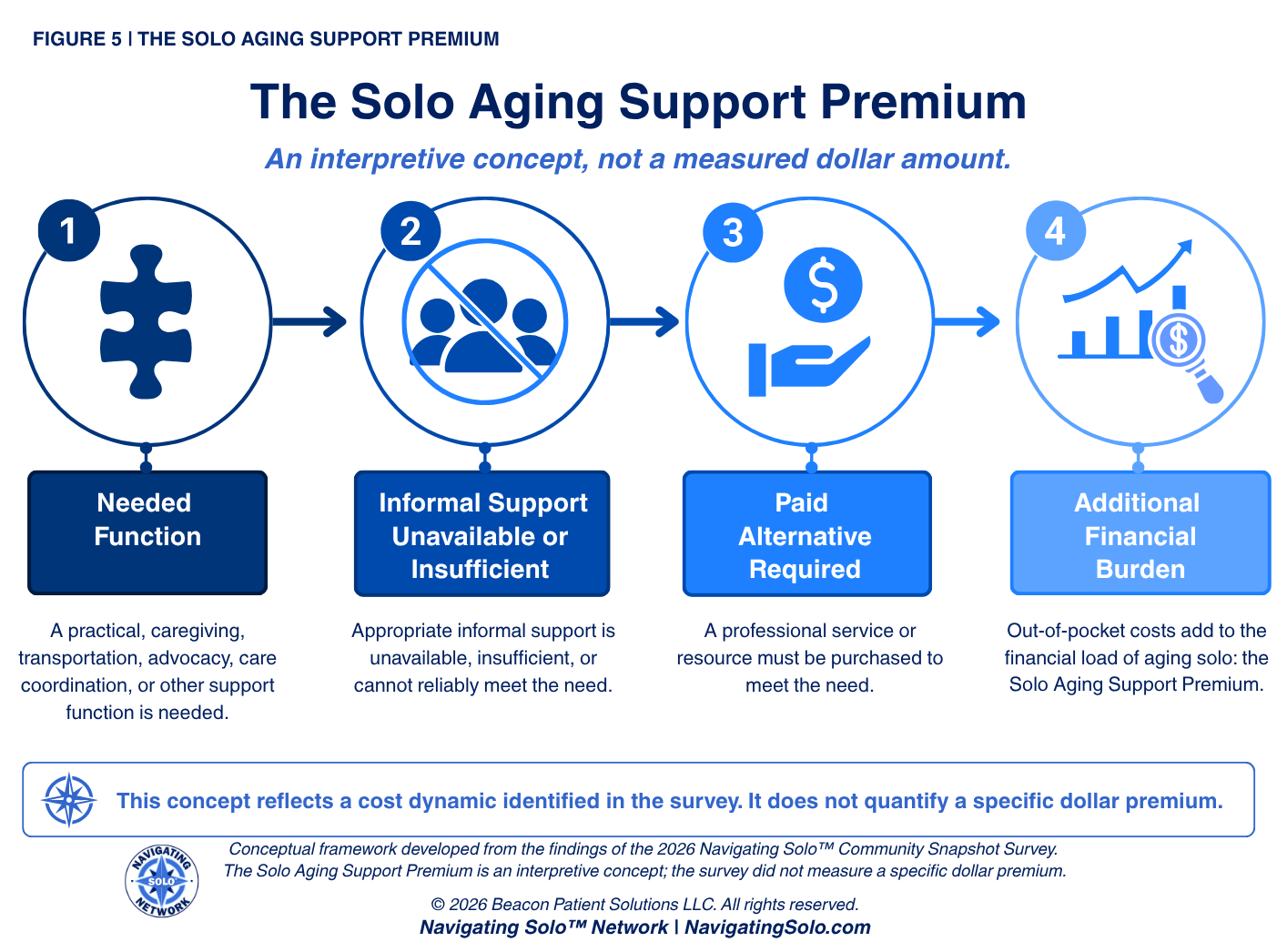
Click image to enlarge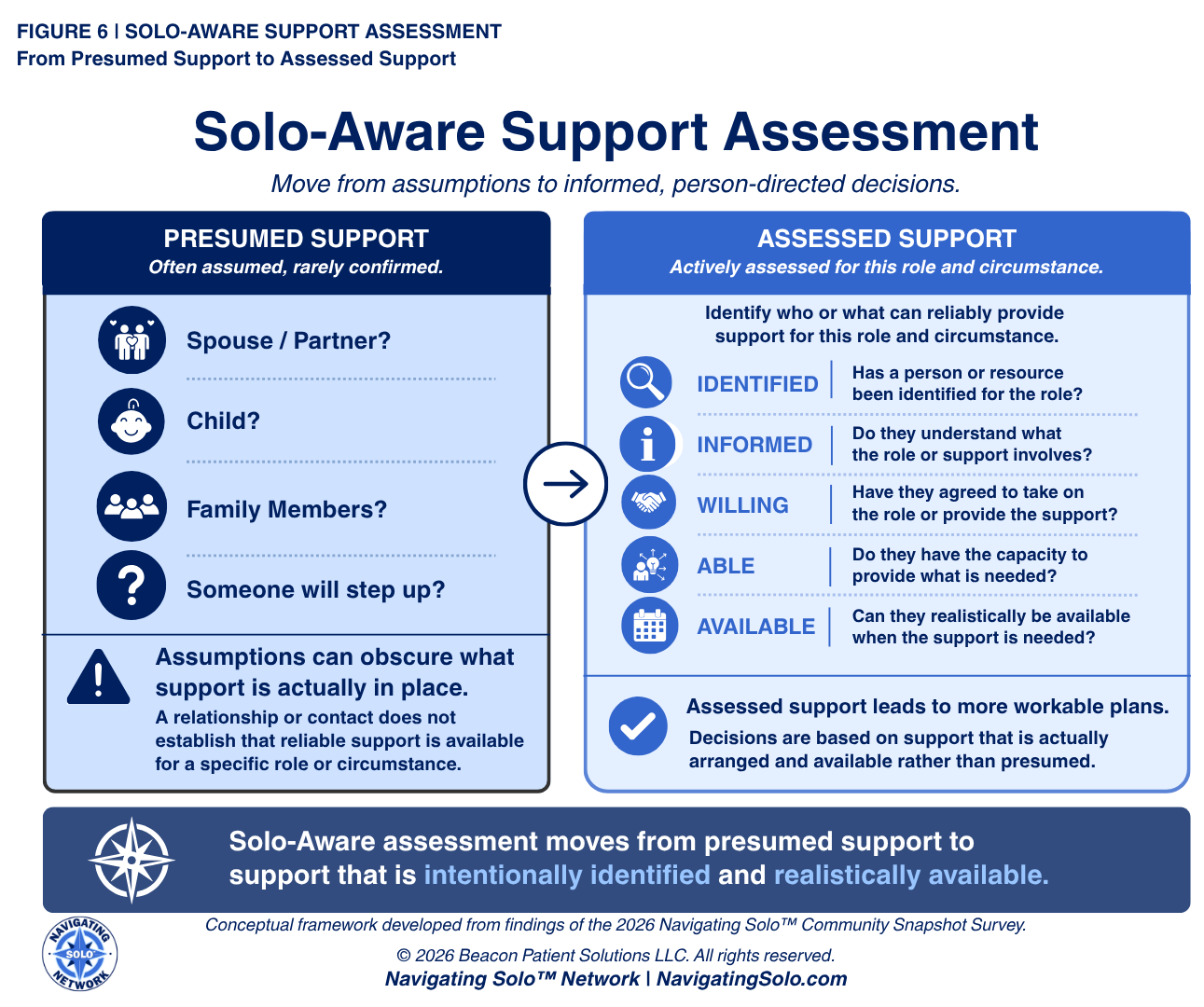
Click image to enlargeFigure 1
Solo Aging Across Different Circumstances
Solo aging can arise across different living arrangements, partnership statuses, parental circumstances, and family structures. The more useful planning question is whether reliable, appropriate support can be counted on when it is needed.
PNG • May be shared for educational and noncommercial use with attribution.
Figure 2
Planning Concerns Frequently Co-Occur
Planning concerns rarely stood alone. 95.9% of respondents selected at least two of the 11 concern areas, and respondents selected 4.94 concerns on average. The pattern reinforces the need to approach solo aging planning holistically rather than as a series of isolated tasks.
PNG • May be shared for educational and noncommercial use with attribution.
Figure 3
Architecture of Support
A support network identifies the people and resources around someone. An Architecture of Support goes further by intentionally organizing trusted people, skilled professionals, clearly understood roles, practical services, communication pathways, and backup options so support can be reliably activated when needed.
PNG • May be shared for educational and noncommercial use with attribution.
Figure 4
The Four Dimensions of Meaningful Access
The existence of a resource does not necessarily mean a person can actually use it. Meaningful Access depends on four interconnected conditions: Availability, Appropriateness, Capability, and Affordability.
PNG • May be shared for educational and noncommercial use with attribution.
Figure 5
The Solo Aging Support Premium
When appropriate informal support is unavailable, some people navigating solo aging may need to purchase functions that others can obtain through personal relationships. The paper refers to this additional financial burden as the Solo Aging Support Premium - an interpretive concept, not a specific dollar amount measured by the survey.
PNG • May be shared for educational and noncommercial use with attribution.
Figure 6
Solo-Aware Support Assessment
Solo-Aware practice begins by assessing actual support rather than presuming it from family structure, partnership status, or social connection. It asks what support is really in place for a particular role or circumstance - and what alternatives or backups may be needed when that support is unavailable.
PNG • May be shared for educational and noncommercial use with attribution.
Ready to explore the full findings?
Who This Paper Is For and Why It Matters
Why It Matters
Solo aging is not framed by one living arrangement or family structure. It becomes a planning consideration whenever reliable support cannot simply be assumed.
The findings show that effective preparation depends on more than information, documents, or individual effort. Plans also rely on people, professional resources, practical services, accessible systems, and backup options that can function when circumstances change.
The paper therefore asks individuals, professionals, organizations, communities, and systems to look beyond who is presumed to be available and consider what support is actually available, appropriate, capable, and accessible when needed.
Solo aging is not a crisis to be solved. It is a reality to be supported.
Who Can Use This Work
Individuals navigating solo aging
For thinking more intentionally about planning, support, access, and backup.
Healthcare and aging-services professionals
For examining assumptions about family, caregivers, discharge, decision-making, and support.
Legal, financial, advocacy, and planning professionals
For considering whether the people and resources needed to carry out a plan are actually in place.
Community organizations and service providers
For designing connection, resources, and services that do not depend on traditional family structures.
Researchers, educators, policymakers, and system leaders
For identifying questions, practices, and structures that warrant further attention and change.
About the Survey
The 2026 Navigating Solo™ Community Snapshot Survey was designed to better understand the experiences, concerns, planning realities, and support needs associated with navigating solo aging.
A total of 507 people participated. The survey included structured-response questions about planning concerns, barriers, current and desired support, confidence, emotional experience, and professional and community resources, along with opportunities for respondents to describe their experiences in their own words.
The survey was designed as a community snapshot, not a nationally representative study. Participation was voluntary and self-selected, and respondents were predominantly female and White, with greater geographic representation from the Northeast and West. These characteristics are important boundaries when interpreting the findings.
The white paper reports the quantitative findings as submitted, analyzes the open-ended responses thematically, and identifies methodological limitations where survey configuration affected interpretation.
That language tracks the methodology in the final paper.
At a Glance
507
15
2
Respondents
Survey Questions
Open-Ended Questions
The survey instrument contains 15 questions, with Questions 8 and 15 providing the open-ended responses used for the qualitative analysis.
Complete survey methodology, limitations, quantitative results, qualitative findings, and the survey instrument are included in the white paper.
Citation & Use
Suggested Citation
Gerhardt, A. (2026). Navigating Solo: What 507 Voices Reveal About Planning, Support, and Systems for Solo Aging. Beacon Patient Solutions LLC.
Sharing & Educational Use
Brief quotations and figures may be reproduced and shared for educational and noncommercial purposes with appropriate attribution to Navigating Solo™ Network and this publication.
Figures should not be altered in ways that change their meaning or remove source attribution.
© 2026 Beacon Patient Solutions LLC. All rights reserved.
For permissions or other uses, contact Navigating Solo™ Network through NavigatingSolo.com.